Why the Sugar Industry Needs an ETP Wastewater Treatment Plant
A sugar mill runs hard for a few months and then goes quiet. During the crushing season it handles thousands of tonnes of cane a day, washing, boiling, evaporating and cooling around the clock, and the water leaving the plant carries sugar, molasses, bagasse fibre, lime, oil and heat. When the season ends, the flow drops sharply or stops altogether. That on-off pattern, together with a high organic load, is what makes a sugar mill's effluent treatment plant (ETP) different from most others. This article explains why a sugar mill needs an ETP, what it has to treat, and how the plant is designed to cope with the season.
Where sugar mill wastewater comes from
- Cane yard and mill house: washing of cane, floors and milling equipment, carrying juice, soil, bagasse fibre and lubricating oil.
- Juice clarification and filtration: lime, sulphur compounds, filter cake washings and press mud residues.
- Evaporators and pans: large volumes of condensate. Much of it is relatively clean, but it can carry traces of sugar, ammonia and volatile compounds, particularly after entrainment or leaks.
- Cooling and spray ponds: overflow and blowdown that picks up contamination when process leaks or sugar carry-over reach the cooling circuit.
- Boiler house and utilities: boiler blowdown, ash handling water and water-treatment reject.
- Spills and washdowns: juice, syrup and molasses that reach the drain are the most concentrated and most damaging part of the load.

What makes sugar mill effluent challenging
- High, mostly biodegradable organic load. Sugars are consumed very quickly by bacteria, so the BOD is high and oxygen disappears fast in any receiving water. The combined effluent can reach COD of a few thousand mg/L, and spills of molasses or syrup can push it far higher for short periods.
- Rapid souring and odour. Sugar-rich effluent ferments within hours if it is held without mixing or aeration, producing acids and foul odour.
- Fibre, solids and oil. Bagasse fibres clog screens and pumps, and oil and grease from machinery coat tanks and interfere with biological treatment.
- Heat and variable pH. Hot condensate and blowdown raise the temperature, and lime, acids and cleaning chemicals swing pH.
- Strong seasonality. Crushing typically runs for several months a year, with stoppages for breakdowns or cane shortages. The plant has to start up quickly each season and keep its biology alive when the mill is idle.
- Integration with other units. Many mills run co-generation plants and some have distilleries, which add their own streams and make the water balance more complex.
Why an ETP is not optional
Regulatory consent. Sugar mills operate under consent from the State Pollution Control Board, with discharge conditions on BOD, suspended solids, oil and grease, pH and other parameters, depending on whether effluent goes to surface water, land or a sewer. Land application, where permitted, comes with its own conditions. Non-compliance can lead to penalties and closure directions, and the rules differ by state, so they should be confirmed with the Board before design.
Protecting rivers, canals and soil. Sugar-rich effluent can strip a stream of oxygen and cause fish kills in a matter of days. Mills sit in cane-growing belts, often beside rivers and irrigation canals that farmers and villages depend on.
Water security. Cane itself is roughly 70 percent water, so a well-run mill can recover much of its process water from condensates, but only if that water is collected, kept clean and treated. Mills in groundwater-stressed regions benefit most from closing the water loop.
Product and cost. Sugar and molasses in the drain are lost product. Monitoring the load in the effluent often points to leaks, entrainment and housekeeping problems that are worth fixing in themselves.
Community and customer expectations. Odour and river pollution draw complaints quickly, and buyers and lenders increasingly ask about environmental performance.
How a sugar mill ETP is built
- Stream segregation. The most useful design decision. Clean condensate and cooling water are kept apart from strong washings and spills, so the ETP treats only what needs treating and the clean streams can be recovered and reused directly.
- Screening and oil removal. Bar and fine screens remove bagasse fibre, followed by an oil and grease trap.
- Equalisation, cooling and pH control. A mixed, aerated balancing tank absorbs spills and shift-to-shift swings and prevents the effluent souring. Temperature and pH are brought into range for biology.
- Anaerobic stage, where the load justifies it. A digester or UASB reactor can remove a large share of the organic load with little energy and produce biogas, but it needs a steady feed and takes time to start up, which matters in a seasonal plant.
- Aerobic treatment. SBR, MBBR or AMBBR, or conventional activated sludge, remove the remaining BOD and COD. See below for seasonal considerations.
- Clarification and polishing. Settling, filtration and disinfection, with UF and RO added where water is to be reused at higher quality or discharge is restricted.
- Condensate recovery. Evaporator and pan condensate is tested, cooled and polished as needed, then reused in cooling make-up, washing, imbibition water in some mills, or boiler feed after further treatment.
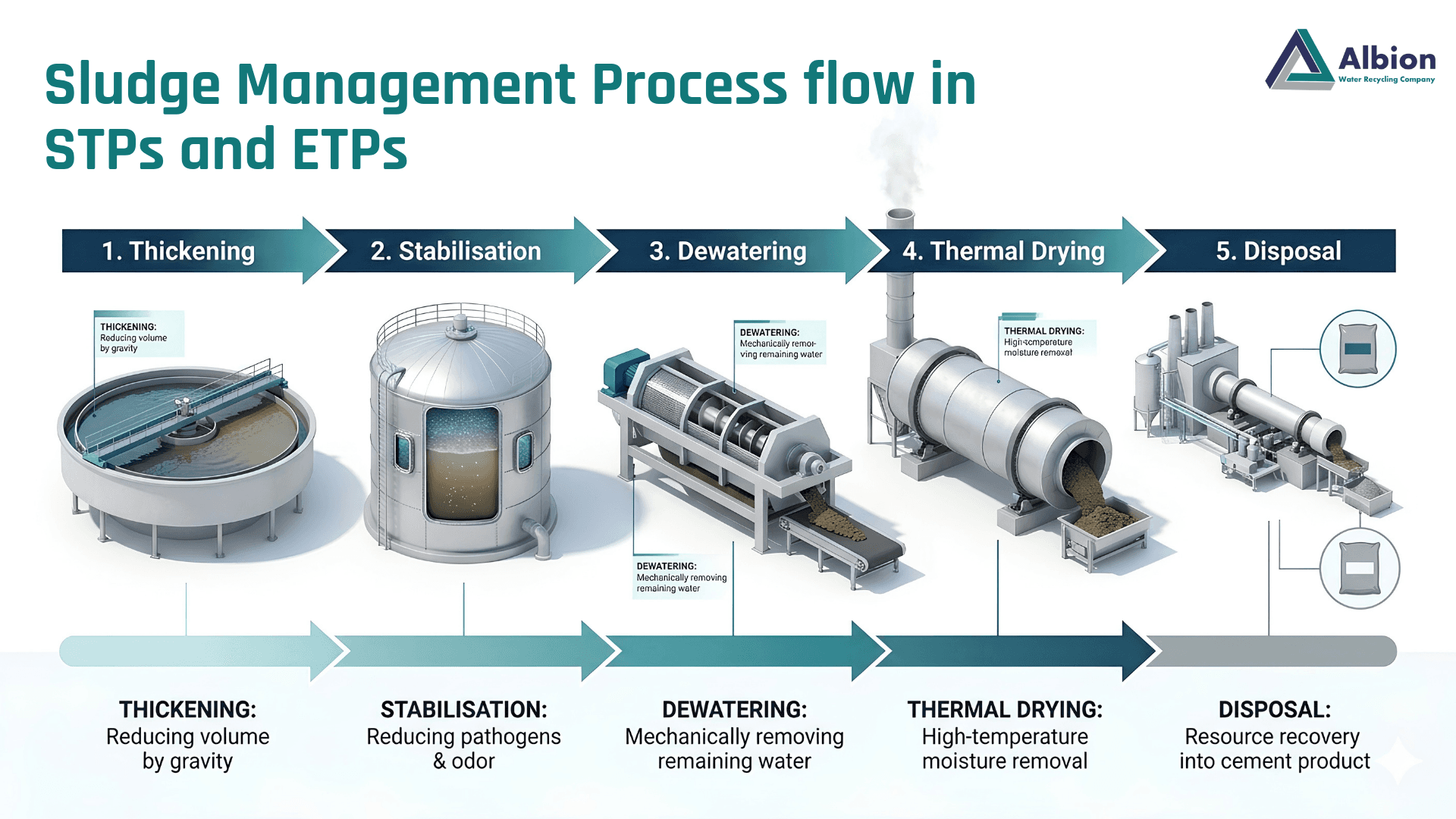
- Sludge handling. Biological sludge is thickened and dewatered. Where rules and quality allow, it may be blended into press mud composting, but the route should be confirmed locally.
Designing for the season and the off-season
Most of the engineering difficulty in a sugar mill ETP is about timing rather than chemistry. Biomass has to be ready on the first day of crushing, hold up through stoppages, and survive months with little or no feed.
- AMBBR and MBBR hold biomass as a biofilm on carriers, which tends to recover faster after idle periods and copes well with spills and sudden loads. This makes them a practical choice for seasonal, variable effluent on a limited plot.
- SBR can adjust cycle times to a low or intermittent flow, which suits stoppages and the shoulders of the season.
- MBR suits mills that want reuse-grade water in a small footprint, but membranes need careful preservation and restart in the off-season, and fibre and oil must be removed well beforehand.
- Keeping biology alive off-season. Options include recirculating at low aeration with a small feed, using domestic sewage from the colony if available, or preserving seed sludge. The approach should be agreed at design, along with a start-up plan that does not rely on weeks of acclimatisation while the mill is already crushing.
Cut the load before the ETP
- Fix leaks and entrainment, and fit sugar and conductivity monitors on condensate and cooling water so contamination is caught early.
- Dry-clean floors and handle spills of syrup and molasses as product, not washdown.
- Recover and reuse condensate and keep it out of the ETP flow.
- Control cooling and spray pond water so process contamination does not pass into it.
- Meter water by section to find where use is highest.
Common mistakes
- Mixing clean condensate with strong effluent, so the ETP is oversized and clean water is wasted.
- Sizing for peak crushing flow and ignoring how the plant will cope at low flow and off-season.
- Underestimating spill loads from syrup and molasses, which can upset a plant sized only for average load.
- Letting bagasse fibre and oil reach the biological stage.
- Leaving the equalisation tank unmixed so it sours before treatment.
- Having no plan for start-up each season, and so spending weeks out of compliance.
How Albion Ecotech approaches sugar mill ETPs
Albion Ecotech designs sugar mill ETPs from measured data on each stream: flow and strength across crushing and stoppages, fibre and oil content, spill risk, condensate quality and the discharge or reuse target. Depending on the mill, that means segregating clean and strong streams, screening and oil removal, an aerated equalisation stage, a biological stage selected from AMBBR, MBBR and SBR, or MBR, and UF, RO or ZLD where reuse or regulation calls for it. Start-up and off-season operation are planned at design stage. Sludge management, energy-efficient aeration, PLC-based automation and post-commissioning support are part of the scope, and plants can be supplied in packaged or civil formats.
Frequently Asked Questions
Why does a sugar mill need an ETP?
Sugar mill effluent is high in biodegradable organic matter, fibre, oil and heat, and can strip rivers and canals of oxygen within days. An ETP is needed to meet consent conditions, protect water bodies and recover water for reuse.
Can a sugar mill reuse its condensate?
Yes. Evaporator and pan condensate is a major source of reusable water, used for cooling make-up, washing and, after suitable treatment, boiler feed. It should be tested for contamination and kept apart from strong effluent.
How does a seasonal mill keep its ETP working in the off-season?
Common approaches are low-rate recirculation with a small feed, using colony sewage where available, or preserving seed sludge. Attached-growth systems such as AMBBR and MBBR also tend to recover faster at restart. The plan should be set at design.
Which biological process suits a sugar mill ETP?
AMBBR, MBBR and SBR handle seasonal and spill-driven load variation well, while MBR suits mills that want reuse-grade water in a small footprint. An anaerobic stage can help where load is high and steady during crushing.
Can treated effluent be used for irrigation?
In some places and under conditions, yes. Whether land application is permitted, and the quality required, depends on the state and the consent, so it should be confirmed with the State Pollution Control Board.