
U-Flocs Ultrafiltration (UF) System
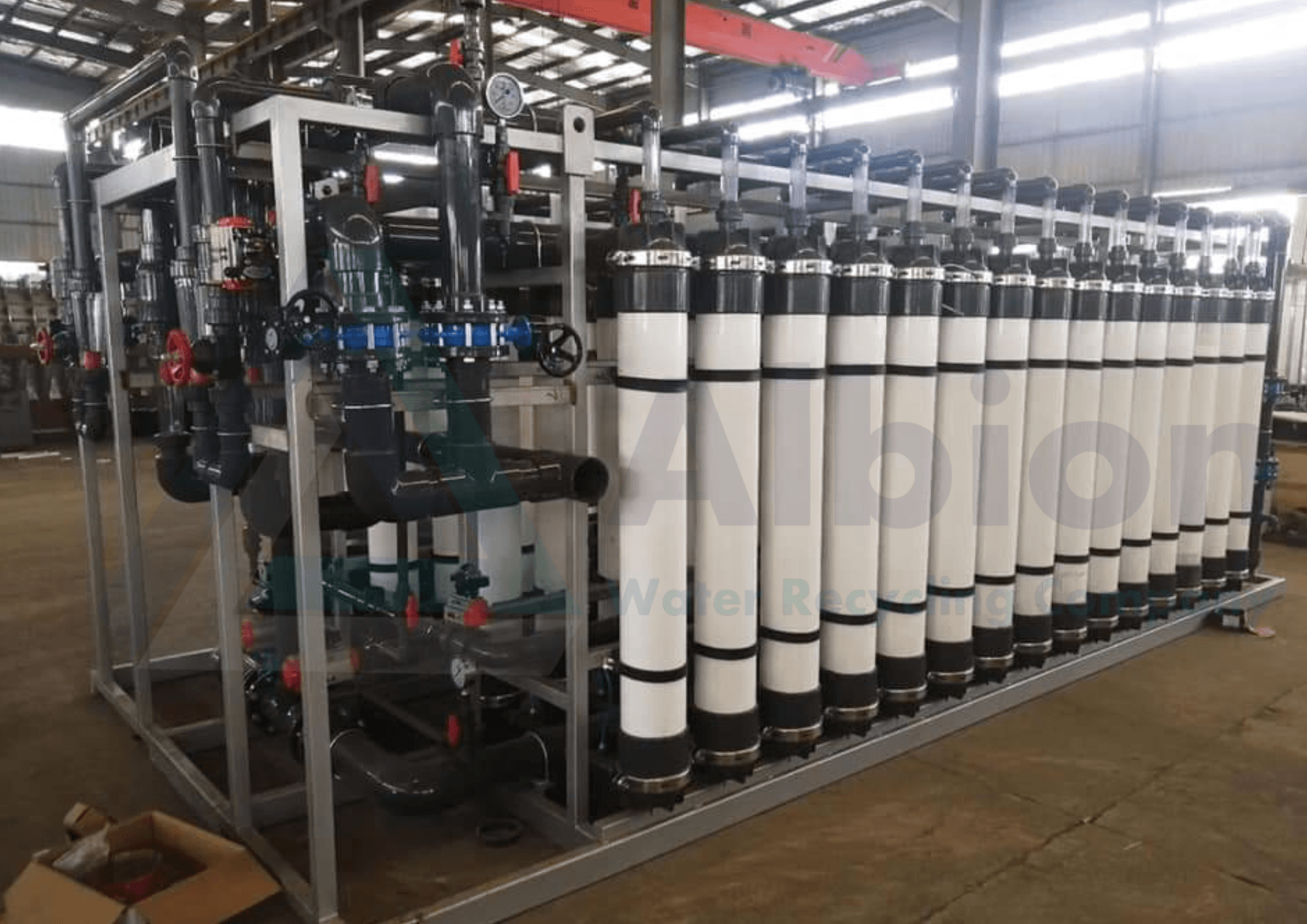
Membranes & Filtration MediaU-Flocs UF System uses 0.02–0.1 μm pressure-driven membranes to remove bacteria, viruses & particulates - ideal for RO pre-treatment and effluent polishing.
Enquire about this product
Specifications
- Technology
- Ultrafiltration (UF) membrane separation
- Separation Principle
- Pressure-driven filtration
- Filtration Pore Size
- 0.02 μm – 0.1 μm
- Operating Temperature
- Room temperature
- Phase Change
- None
- Feed Flow Configuration
- Inside the shell or in the lumen of the fibres
- Rejected Contaminants
- Viruses, particulates, bacteria, endotoxins, and other suspended microbes
- Separation Capability
- Rejects both insoluble and soluble substances
- Chemical Usage
- Chemical-free process
Features
Pressure-Driven Membrane Filtration
Uses hydraulic pressure to drive water through the membrane, providing a physical (rather than chemical) separation mechanism.
Tight Pore Size Range (0.02 μm – 0.1 μm)
A precisely controlled pore range creates a reliable physical barrier against viruses, bacteria, and fine particulates.
Barrier Against Pathogens and Microbes
Acts as a rejective barrier to viruses, bacteria, endotoxins, and other suspended microorganisms, reducing microbial load in the treated stream.
Chemical-Free Separation Process
Achieves separation without added chemicals, simplifying operation and avoiding chemical dosing and handling.
Room-Temperature Operation
Operates at ambient temperature with no phase change required, avoiding the energy demand associated with thermal separation processes.
No Re-Pollution
The filtration process does not reintroduce contaminants into the treated stream, supporting consistent output water quality.
Flexible Feed Flow Configuration
Feed water can flow either inside the shell or through the lumen of the membrane fibres, allowing configuration to suit different system designs.
Removal of Both Insoluble and Soluble Substances
Capable of rejecting a broad range of contaminant types, extending beyond simple suspended solids removal.
Outcomes
Consistent Pathogen and Particulate Barrier
The 0.02 μm – 0.1 μm pore range provides a dependable barrier against viruses, bacteria, and suspended particulates in the treated water.
Reduced Microbial Load
Rejection of bacteria, viruses, and endotoxins supports microbial reduction in the outlet stream.
Simplified, Chemical-Free Operation
A chemical-free separation process reduces the complexity and handling associated with chemical dosing systems.
Stable Output Water Quality
Operation with no re-pollution supports consistent treated water quality over the filtration cycle.
Energy-Conscious Operation
Filtration at room temperature with no phase change avoids the energy overhead of thermal separation methods.
Effective RO Membrane Protection
As a pre-treatment barrier, U-Flocs removes particulates and microbes that would otherwise foul or damage downstream reverse osmosis membranes.
Improved Effluent Quality for Reuse
Used as a polishing step after ETP/STP treatment, U-Flocs helps bring treated effluent closer to reuse or stringent discharge quality standards.
About
U-Flocs is an ultrafiltration membrane system that uses pressure-driven separation to remove viruses, bacteria, particulates, endotoxins, and other suspended microbes from water. The membrane operates within a filtration pore range of 0.02 μm to 0.1 μm, fine enough to physically reject a wide range of insoluble and soluble contaminants while allowing purified water to pass through. Feed water is introduced either inside the shell or through the lumen of the membrane fibres, depending on system configuration. The process runs at room temperature, involves no phase change, and does not reintroduce contaminants into the treated stream, distinguishing it from thermal or chemical-based separation methods. Because ultrafiltration relies on physical rejection rather than chemical treatment, U-Flocs offers a straightforward, chemical-free approach to particulate and microbial separation, making it suitable both as a standalone filtration step and as a pre-treatment or polishing stage within a larger water treatment train.
How It Works / Process

Feed water enters the U-Flocs system and is directed either inside the membrane shell or through the lumen of the hollow fibre membranes, depending on the system configuration. Pressure drives the water through the ultrafiltration membrane, whose pore structure — in the 0.02 μm to 0.1 μm range — physically rejects viruses, bacteria, endotoxins, particulates, and other suspended and soluble contaminants. Because the process is purely physical, it occurs at room temperature with no phase change, and the rejected contaminants are not reintroduced into the treated stream. The result is a filtered permeate stream suitable for further treatment (such as RO feed) or for direct use, depending on the application.
Industrial Use Cases
- Lake & River Water Filtration — Removes turbidity, bacteria, and suspended solids to support safe potable and process water production from surface water sources.
- Pre-Treatment for RO Systems — Protects reverse osmosis membranes by removing colloids, organics, and fine particulates ahead of the RO stage.
- Post-Treatment of ETP / STP Projects — Polishes treated effluent from effluent and sewage treatment plants to help meet stringent discharge and reuse quality standards.
Treatment Objectives
- Suspended solids and particulate removal
- Turbidity reduction
- Bacteria, virus, and endotoxin rejection
- Microbial load reduction
- Pre-treatment / feed water conditioning for RO systems
- Effluent polishing and tertiary treatment
- Water reuse preparation
Upgrade & Retrofit Applications
Confirmed Applications (Supported by Product Data)
- New or upgraded pre-treatment stage ahead of reverse osmosis systems, to protect RO membranes from colloids, organics, and fine particulates.
- Post-treatment polishing stage for existing ETP/STP systems, to improve treated effluent quality for discharge or reuse.
- Primary or supplementary filtration stage for lake and river water intended for potable or process water use.
General Compatibility Considerations
- As a pressure-driven, chemical-free membrane process, U-Flocs may be considered for modernizing existing filtration stages where chemical dosing or thermal treatment steps are being reduced or eliminated. Suitability for a specific retrofit should be confirmed against the existing plant's feed water quality, hydraulics, and treatment objectives.
Why Choose This Product
- Precise pore range (0.02 μm – 0.1 μm) delivers a reliable physical barrier against viruses, bacteria, and particulates.
- Chemical-free operation simplifies process control and avoids chemical handling and dosing.
- Room-temperature process with no phase change avoids the energy demand of thermal separation methods.
- No re-pollution supports consistent treated water quality.
- Flexible feed configuration (shell-side or lumen-side flow) allows adaptation to different system designs.
- Proven role as RO pre-treatment and effluent polishing stage, supporting integration into broader treatment trains.
Performance Advantages
- Effective particle removal across a defined pore size range.
- Chemical-free separation process, reducing operating complexity.
- Prevention of pathogen passage through the membrane barrier.
- Microbial reduction in the treated water stream.
Frequently Asked Questions (FAQ)
Related
%20Wastewater%20Treatment%20Plants.jpg&w=3840&q=75)
Discuss your project
Tell us about your effluent characteristics and treatment targets, and our engineers will recommend the right configuration.
Start a project enquiry