Sludge Management in STPs and ETPs: From Thickening to Disposal
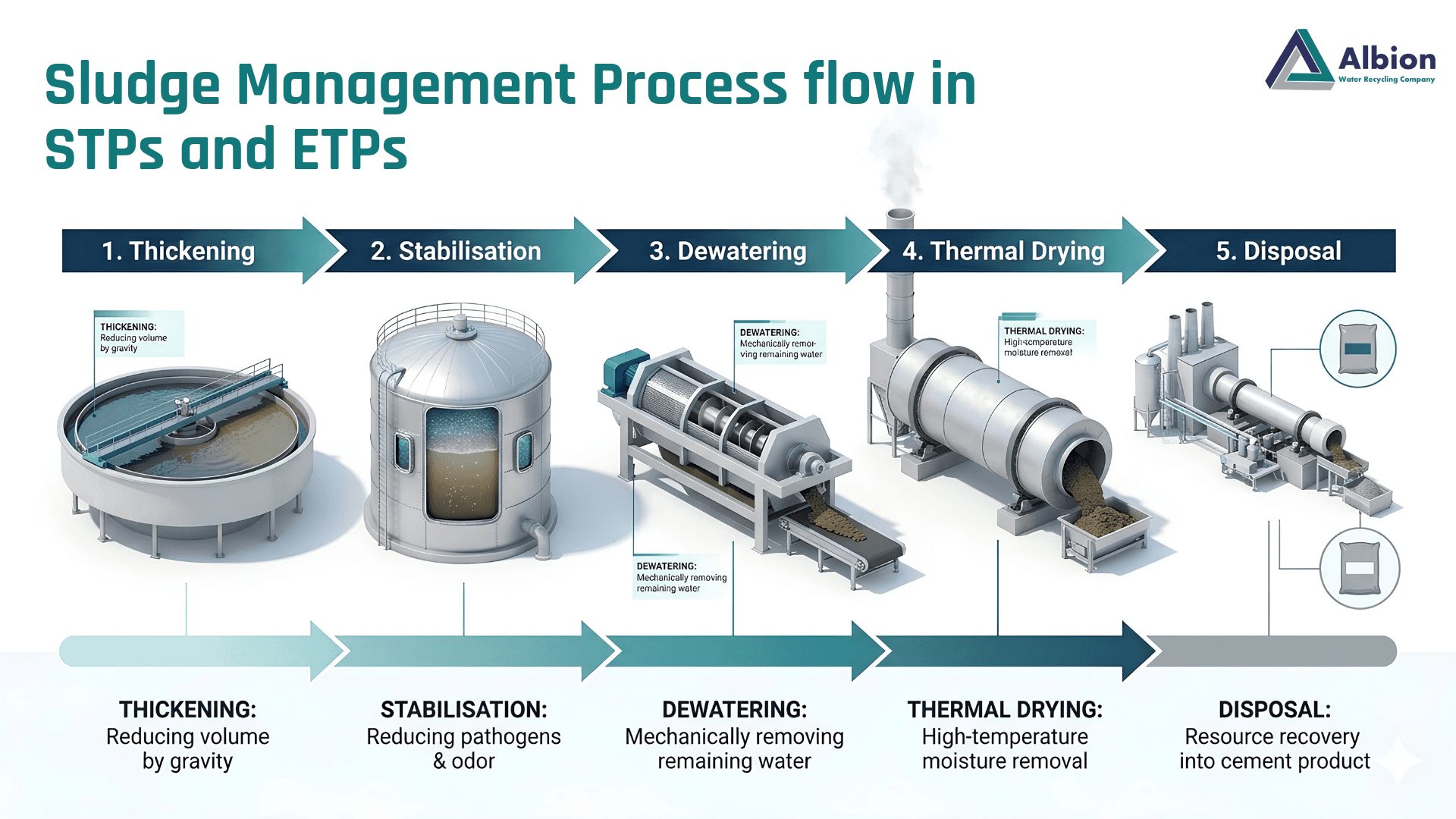
Every biological wastewater plant produces sludge, and in many plants it becomes one of the largest recurring costs once hauling, polymer and labour are counted. Sludge is also the part of the plant most often left until late in the design, when tank sizes and equipment are already fixed. This article walks through how sludge is generated, how it is thickened, stabilised and dewatered, where it can go afterward, and how process and operating choices change the amount a plant has to deal with.
Where sludge comes from
- Primary sludge: settled solids from primary clarifiers or settling tanks, where these are part of the plant.
- Biological (waste activated) sludge: excess biomass produced as microorganisms consume the organic load. In MBBR and AMBBR systems this appears as biofilm that sloughs off the carriers and is captured in the downstream clarifier or membrane stage.
- Chemical sludge: precipitates formed by coagulation and flocculation in physico-chemical treatment, common in textile, pharmaceutical and other industrial ETPs.
The character of the sludge matters as much as its quantity. Biological sludge is organic and can putrefy, so it needs handling before disposal. Chemical sludge is denser and dewaters differently, and depending on the industry and the contaminants it carries, it may be classified as hazardous waste, which changes the permitted disposal route.
Why volume is the real problem
Sludge leaves the process as mostly water. Waste activated sludge commonly contains around one percent solids or less, so a small mass of dry solids arrives as a large volume of liquid. Because the dry solids stay the same as water is removed, the volume falls in inverse proportion to solids concentration. Thickening sludge from 1% to 4% solids cuts its volume to about a quarter, and every downstream step, pumping, dewatering, transport and disposal, is then sized on that smaller volume. This is why the stages below are ordered from cheapest volume reduction to most expensive.
Stage 1: Thickening
Thickening raises solids concentration before dewatering. Gravity thickeners are simple and suit denser primary and chemical sludges. Waste activated sludge is lighter and thickens poorly by gravity alone, so mechanical options such as dissolved air flotation, gravity belt or rotary drum thickeners are used, often with polymer. In small plants a well-designed sludge holding tank with decanting can do part of the job at very low cost. The right choice depends on the sludge type, the daily dry-solids load and the operator skill available.
Stage 2: Stabilisation
Stabilisation reduces odour and pathogen content and makes sludge safer to store and handle. Aerobic digestion is common in small and medium plants because it is simple, though it consumes aeration energy. Anaerobic digestion is generally reserved for larger installations, where the biogas can offset energy. Lime stabilisation is another option where space and digestion time are limited. Not every industrial sludge needs biological stabilisation, especially chemical sludge from physico-chemical stages, so this step should be decided from the sludge characteristics rather than applied by default.
Stage 3: Dewatering
Dewatering turns thickened sludge into a handleable cake. The main options differ in cake dryness, footprint, power, polymer need and skill required.
- Sludge drying beds: low energy and low skill, but they need land and are affected by rainfall, so they suit small plants in drier settings.
- Belt filter press: continuous, moderate power, needs polymer and regular belt washing.
- Centrifuge: compact and enclosed, which helps with odour, but with higher power use and wear parts.
- Screw press: slow-speed and low power, well suited to smaller flows and sludge with oil or grease, with moderate footprint.
- Plate-and-frame filter press: typically gives the driest cake, which is valuable for chemical sludge and where disposal is charged by weight, but it is batch-operated and more labour-intensive.
Cake dryness depends heavily on the sludge itself, the conditioning chemical and the machine, so it should be confirmed through trials on the actual sludge rather than taken from a brochure. Polymer dose is one of the main operating costs here, and jar or bench testing at intervals keeps it matched to the sludge as it changes.
Stage 4: Disposal and reuse
The end route should be settled before the equipment is chosen, because it decides how dry the cake needs to be and whether stabilisation is required.
- Stabilised domestic sludge can sometimes be used as a soil conditioner or composted, subject to quality and the applicable rules for the location.
- Co-processing in cement kilns or other authorised facilities is an option for some industrial sludges.
- Sludge classified as hazardous must go to an authorised treatment, storage and disposal facility with the required documentation.
- Landfill remains a route where permitted, and its cost is the reason cake dryness matters so much.
Classification and permitted routes depend on the industry, the composition and the state rules, so the sludge should be tested and the route confirmed with the relevant authority.
Reducing sludge at the source
Operate at the right sludge age. Longer sludge retention generally lowers the sludge yield per kg of BOD removed, but it can raise aeration energy. The balance depends on the plant.
Choose the process with sludge in mind. MBR runs at a high biomass concentration and long sludge age, which can give lower yield. SBR and AMBBR produce sludge that still needs planned handling. None removes the need for a sludge train, and yield differences depend on how each plant is operated.
Cut chemical sludge at the dosing point. Overdosing coagulant produces sludge with no treatment benefit. Dosing controlled by measurement, and regular jar tests, keep chemical sludge to what the treatment needs.
Segregate streams. Keeping a hazardous stream out of a larger non-hazardous one can keep the bulk of the sludge out of the expensive disposal category.
How to choose a sludge train
- Estimate the daily dry-solids production and the sludge type from the process design and, for industrial plants, from measured effluent data.
- Confirm the disposal route and the cake dryness it requires.
- Check available space, power, water for washing and the skill of the operating team.
- Compare options on total annual cost, including polymer, power, labour, wear parts and hauling, not on machine price alone.
- Run bench or pilot trials on the real sludge before final selection.
Where Albion Ecotech fits
Albion Ecotech includes sludge management in the design of STPs and ETPs from the start, alongside the biological process, rather than adding it after commissioning. That covers estimating sludge quantity for the chosen process, selecting thickening and dewatering equipment to suit the sludge type, site and disposal route, and sizing polymer and chemical dosing so that sludge and OPEX stay in check. The approach applies across SBR, MBBR/AMBBR and MBR plants, in packaged or civil formats, and extends to reuse trains with UF, RO and ZLD, where additional solids streams have to be planned for.
Frequently Asked Questions
Why is thickening done before dewatering?
Because sludge volume falls sharply as solids concentration rises. Feeding thicker sludge to the dewatering unit lets it be smaller and use less polymer and power for the same solids load.
Which dewatering equipment gives the driest cake?
Plate-and-frame filter presses generally give the driest cake, particularly for chemical sludge, though they are batch machines needing more labour. Actual dryness depends on the sludge and conditioning, so trials on the real sludge are the reliable guide.
Does MBR produce less sludge than SBR or AMBBR?
MBR often operates at a longer sludge age, which can lower the sludge yield, but the result depends on how the plant is run. Every biological process produces excess sludge that needs thickening, dewatering and disposal.
Is industrial ETP sludge always hazardous?
No, but some industrial sludges are classified as hazardous depending on the industry and composition. The sludge should be tested and classified, and the disposal route confirmed with the relevant authority.
How can a plant lower its sludge disposal cost?
By reducing the sludge produced, through sludge age and controlled chemical dosing, and by removing more water before disposal, through better thickening, polymer optimisation and suitable dewatering equipment. Keeping hazardous and non-hazardous streams separate also helps.