Unlocking the Potential: Benefits & Applications of AMBBR Technology
Land availability, energy cost, and the need for stable performance under fluctuating loads are three of the most persistent constraints in wastewater treatment design today. Advanced Moving Bed Bioreactor (AMBBR) technology was developed specifically to address these constraints by packing more biological treatment capacity into a smaller reactor volume, without depending on the sludge settling behaviour that limits conventional activated sludge systems. This article takes a deeper look at the engineering benefits behind AMBBR and works through its applications across different industries in detail.
The Engineering Principle Behind AMBBR, Briefly
AMBBR grows a biofilm of treatment microorganisms on the protected internal surfaces of free-moving plastic carrier media suspended within an aerated tank. Because the biomass lives attached to the carrier rather than fully suspended in the water column, the system can sustain a much higher concentration of active biomass per unit tank volume than a suspended-growth process, and it does so without the return activated sludge (RAS) loop that conventional activated sludge depends on. This single design choice — attached growth instead of suspended growth — is what unlocks most of the benefits discussed below.
Core Benefits of AMBBR Technology
1. Compact Footprint and Space Efficiency
Because the carrier media provides a large protected surface area within a relatively small tank volume, AMBBR can achieve a given treatment duty in a smaller reactor footprint than conventional activated sludge. This matters most on sites where plot area is the binding constraint — urban STPs, industrial plots that need to preserve production area, and CETPs where multiple process trains already compete for space. A smaller biological reactor also reduces the civil cost associated with excavation, formwork, and concrete for that stage of the plant.
2. High Biomass Retention and Treatment Stability
Because the biofilm stays attached to the carrier surface, it is not washed out of the reactor during hydraulic surges the way suspended biomass can be. This gives AMBBR a natural advantage in maintaining a stable population of treatment microorganisms even when flow or organic load varies through the day, which is common in mixed-use developments, hospitality projects, and industrial plants with batch discharge patterns from upstream processes.
3. Resilience to Shock and Variable Organic Loads
Industrial effluent rarely arrives at a constant strength. Batch production cycles, cleaning-in-place (CIP) discharges, and seasonal changes in raw material can all produce short-term spikes in organic load. Because AMBBR's biomass is distributed across a large protected carrier surface rather than concentrated in a single suspended culture, the system tends to absorb these fluctuations more gracefully, reducing the risk of a process upset cascading into non-compliant effluent.
4. Simplified Operation Without Sludge Recycle
Conventional activated sludge requires a return activated sludge (RAS) loop to maintain biomass concentration in the aeration tank, along with continuous monitoring of the sludge volume index to avoid bulking. AMBBR removes this dependency — biomass stays on the carriers rather than needing to be settled and pumped back — which simplifies the process train, reduces the pumping infrastructure required, and lowers the operational complexity for sites without dedicated process engineers on staff.
5. Retrofit and Capacity Enhancement Potential
One of the most practically valuable benefits of AMBBR is that carrier media can often be introduced into existing aeration tanks that are already at or near their organic loading limit. Rather than constructing new tankage, a plant facing rising inflow — due to occupancy growth, urban expansion, or new industrial connections — can potentially add biological treatment capacity within its existing civil footprint. This makes AMBBR one of the more time- and cost-efficient routes to capacity enhancement, subject to a proper hydraulic and structural assessment of the existing tank.
6. Reduced Risk of Sludge Bulking
Filamentous bulking — where poorly settling filamentous organisms dominate the biomass — is a common operational headache in conventional activated sludge, often triggered by low dissolved oxygen or nutrient imbalance. Because AMBBR's biomass is attached to carriers rather than relying on gravity settling for separation in the reactor itself, it is inherently less exposed to this specific failure mode, though downstream clarification can still be affected by any biomass that sloughs off the carriers.
7. Consistent Effluent Quality Across Seasons
Because the attached biomass is more resilient to temperature and load swings than suspended-growth cultures, AMBBR systems tend to maintain more consistent BOD/COD removal performance across seasonal changes in flow and temperature, which is a meaningful advantage for sites that need to demonstrate year-round compliance rather than only average annual performance.
8. A Foundation for Downstream Water Reuse
A stable, well-treated AMBBR effluent is a strong feed for downstream polishing — disinfection, filtration, or membrane treatment such as UF or RO — making it a practical pre-treatment stage for projects with water reuse or recovery goals, since it reduces the organic load that these downstream units need to handle.
Detailed Applications of AMBBR Technology by Industry
Municipal and Government STPs
Municipal sewage flow typically peaks in the morning and evening and drops overnight, with additional seasonal variation from festivals, tourism, or monsoon infiltration into sewer networks. AMBBR's resilience to these fluctuations, combined with its retrofit potential into existing STP tankage as urban populations grow, makes it a practical fit for both new municipal STPs and capacity-constrained existing plants facing rising inflow.
Residential and Commercial Complexes
Housing societies, hotels, and institutional campuses see occupancy-driven flow swings — weekends versus weekdays, holiday seasons, event days — that can strain a conventional activated sludge system's settling performance. AMBBR's tolerance for load variation, along with its compact footprint, suits developments where the STP competes with landscaping, parking, or amenity space for plot area.
Food and Beverage Processing
Food and beverage effluent is generally biodegradable but often high in organic strength, and production schedules can create batch discharges of concentrated wastewater — for example, from cleaning cycles between product runs. AMBBR's shock-load resilience and high biomass density make it well suited to handling these organic peaks without a proportionally larger reactor.
Pharmaceutical Manufacturing
Pharmaceutical ETPs typically use AMBBR as one stage within a larger, multi-stage treatment train that may include physico-chemical pretreatment ahead of the biological stage and advanced oxidation or membrane treatment afterward. AMBBR's stability under variable batch-driven loading is valuable here, since production changeovers can shift effluent characteristics from batch to batch.
Textile and Dyeing Effluent
In textile and dyeing applications, AMBBR generally functions as a biological polishing stage following physico-chemical pretreatment that removes colour and non-biodegradable load. The compact footprint is particularly useful here, since textile ETPs often need to fit within an already congested industrial plot alongside dyeing, printing, and finishing operations.
CETP Projects
Common Effluent Treatment Plants receive mixed wastewater from multiple member industries, which means influent characteristics can shift depending on which units are discharging at a given time. AMBBR's resilience to load and composition variability is a meaningful advantage in this setting, where the biological stage cannot be tuned to a single, predictable influent profile the way a dedicated industrial ETP can be.
Pre-Treatment Ahead of MBR or RO
For projects targeting high-quality reuse water, AMBBR is often positioned as a pre-treatment stage that reduces organic and solids load before a downstream membrane process such as MBR, or before RO in ZLD-oriented systems. This staged approach can reduce fouling load on downstream membranes and improve the overall reliability of the treatment train.
Considerations for Successful AMBBR Implementation
- Correct carrier fill ratio: Under-filling a tank with carrier media will not deliver the expected treatment capacity, while over-filling can hinder mixing efficiency; fill ratio needs to be engineered to the specific influent load.
- Adequate aeration design: Carriers must be kept in continuous, even motion to maintain biofilm health and prevent dead zones, which requires careful diffuser layout and blower sizing.
- Robust retention screens: Outlet screens need to be sized and maintained to prevent carrier loss into downstream units while avoiding clogging that restricts flow.
- Appropriate downstream clarification: AMBBR is a biofilm treatment stage, not a complete solids-separation solution, so a properly sized clarifier or membrane stage is still required afterward.
- Retrofit feasibility checks: When adding carriers to an existing tank for capacity enhancement, the existing structure, aeration system, and downstream units all need to be assessed for compatibility with the increased treatment load.
How Albion Ecotech Applies These Benefits Through M-Flocs AMBBR
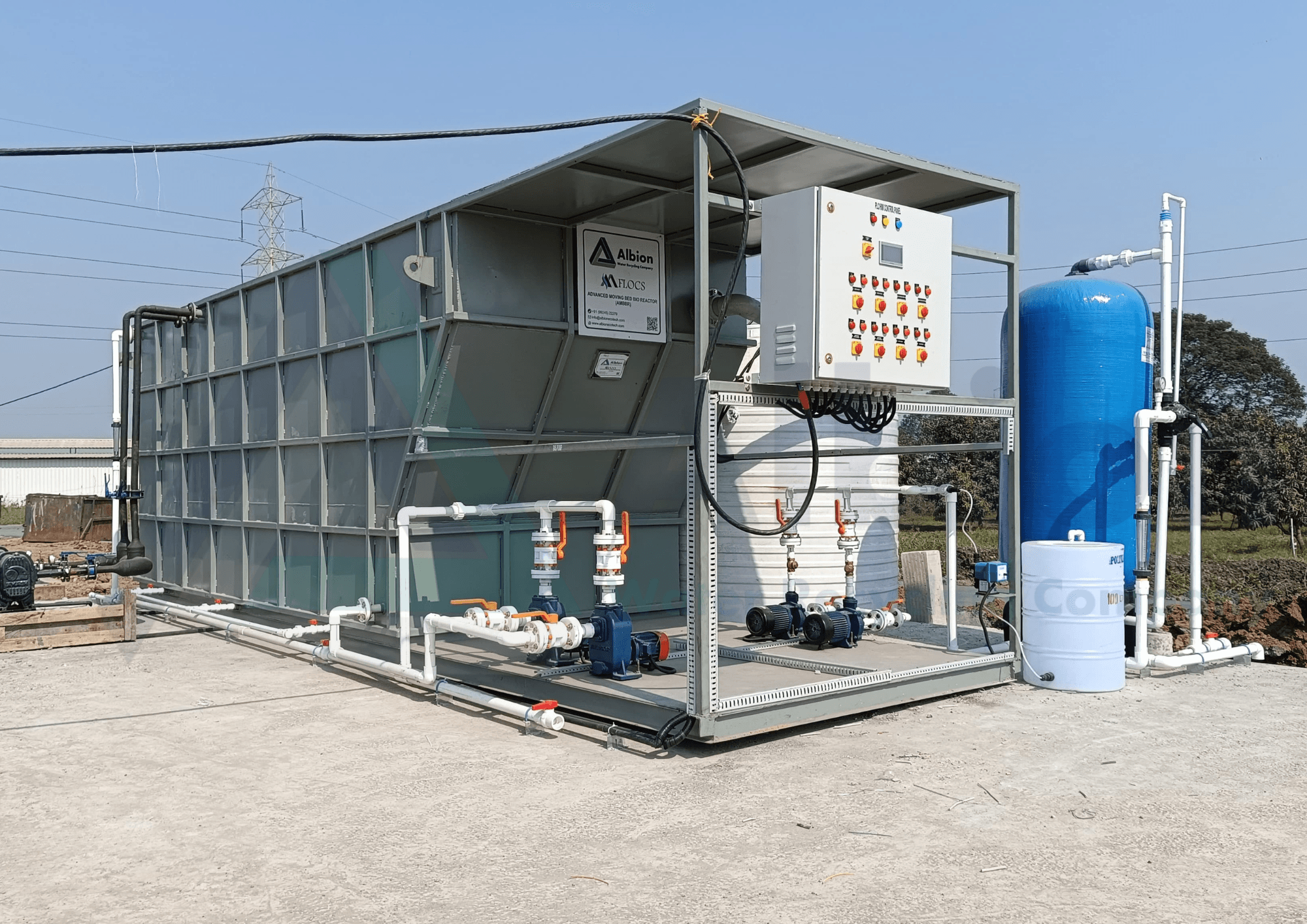
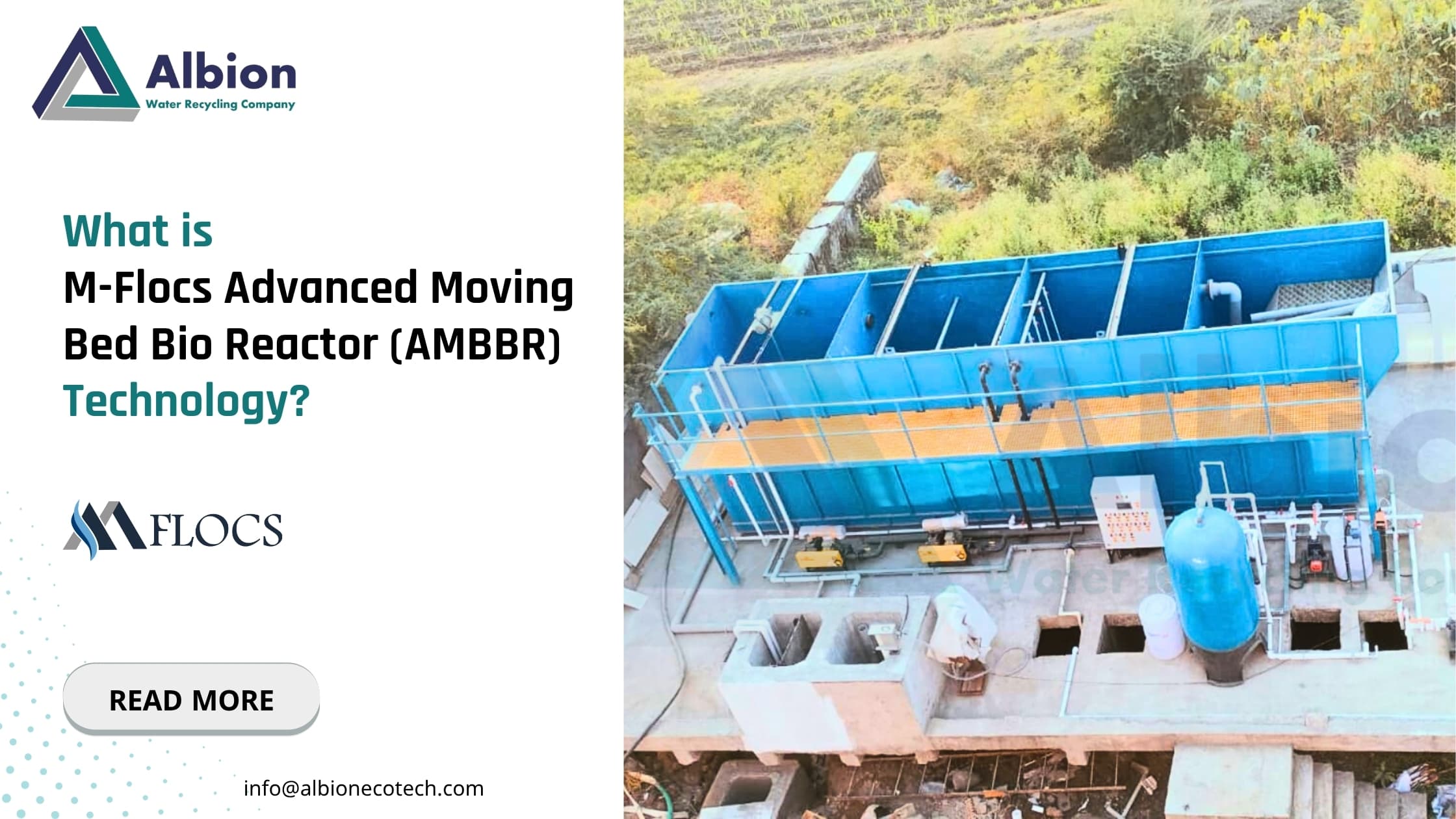
As a wastewater treatment engineering company, Albion Ecotech engineers M-Flocs AMBBR systems around each project's specific organic and hydraulic loading, rather than a standard fill ratio, so that the benefits described above — footprint reduction, load resilience, and retrofit potential — are actually realized on site rather than left to chance. For capacity enhancement projects, Albion assesses the existing tank's structural and hydraulic suitability before recommending a carrier-based retrofit. Where reuse or ZLD goals are part of the project, Albion positions M-Flocs as a pre-treatment stage ahead of downstream MBR, UF, or RO, and plans sludge management for the biomass generated by the process. Energy-efficient aeration equipment selection is factored into the design to help manage long-term OPEX, and Albion supports clients through commissioning and maintenance planning to sustain performance over the plant's operating life.
Conclusion
AMBBR's real value lies in how its attached-growth design principle translates into practical engineering benefits: a smaller footprint, resilience to load swings, simplified operation, and a genuine retrofit path for capacity-constrained sites. These benefits apply across a wide range of industries, from municipal STPs to high-strength industrial ETPs, though realizing them in practice depends on correct sizing, aeration design, and downstream clarification — which is why project-specific engineering, not the technology alone, ultimately determines outcomes.
Frequently Asked Questions
What is the main advantage of AMBBR over conventional activated sludge?
AMBBR's attached-growth biomass allows a higher treatment capacity per unit tank volume and removes dependency on a return activated sludge loop, resulting in a more compact, operationally simpler system that is also more resilient to load fluctuation.
Which industries benefit most from AMBBR technology?
Industries with variable or batch-driven effluent — food and beverage, pharmaceuticals, textiles, and CETPs handling mixed streams — tend to benefit most from AMBBR's shock-load resilience, alongside municipal STPs needing compact, retrofit-friendly capacity enhancement.
Can AMBBR alone achieve reuse-grade water quality?
Generally, no. AMBBR is a strong biological treatment stage but typically needs downstream clarification and, for reuse-grade quality, further polishing through filtration, disinfection, or membrane treatment such as UF or RO.
Is AMBBR more energy-efficient than conventional activated sludge?
Energy use depends on aeration design in both systems. AMBBR does not inherently guarantee lower energy consumption, but its smaller reactor volume and elimination of the RAS pumping loop can offer efficiency advantages when the aeration system is well designed for the carrier fill ratio used.
How reliable is AMBBR for retrofitting an overloaded STP?
AMBBR is a commonly used retrofit approach for capacity enhancement, but reliability depends on a proper assessment of the existing tank's structural condition, aeration capacity, and downstream clarifier sizing before carriers are introduced.
Does AMBBR reduce sludge production compared to activated sludge?
Sludge production depends on organic loading and sludge age rather than the growth mode alone, so AMBBR does not automatically produce less sludge than activated sludge; sludge management still needs to be planned as part of the overall system design.
%20Technology.jpg&w=3840&q=75)