How to Calculate HRT in a Sewage Plant

Hydraulic retention time, or HRT, is one of the first numbers anyone asks for when sizing or troubleshooting a sewage treatment plant. It tells you how long wastewater stays in a tank before moving on, and so how much time the microorganisms, settling or disinfection in that tank have to do their work. The calculation is simple, but small slips in units, depth or flow lead to wrong answers. This guide gives the formula, the steps, worked examples for common tanks and typical design ranges.
What HRT means
HRT is the average time a volume of water spends inside a tank or reactor. It is also called hydraulic detention time or nominal residence time. It depends only on the size of the tank and the flow passing through it, not on what is in the water.
HRT = V ÷ Q
- V is the working volume of the tank, in cubic metres (m³).
- Q is the flow rate, in cubic metres per hour (m³/h) or per day (m³/day).
- HRT comes out in hours if Q is per hour, or in days if Q is per day.
When the flow is given in KLD (kilolitres per day), remember that 1 KLD equals 1 m³/day. To get hours directly from a daily flow, use HRT in hours = V ÷ Q (m³/day) × 24.
Step-by-step method
- Measure the tank. Take the length, width and, most importantly, the side water depth (SWD), which is the depth of water at normal operating level. Do not use the full wall height, since the freeboard above the water line holds no water.
- Calculate the volume. For a rectangular tank, V = length × width × SWD. For a circular tank, V = π ÷ 4 × diameter² × SWD, plus the volume of any conical hopper at the bottom.
- Decide which flow to use. Average daily flow gives the nominal HRT used for process design. Peak flow gives the minimum HRT the tank sees, which should still be acceptable.
- Make units match. Convert so that volume is in m³ and flow is in m³ per the same time unit you want the answer in.
- Divide. HRT = V ÷ Q, then compare the result with the design range for that tank.
Worked examples
Example 1: an equalisation tank
A 500 KLD plant has an equalisation tank 10 m long, 5 m wide, with a side water depth of 3 m. Volume = 10 × 5 × 3 = 150 m³. Average flow = 500 m³/day = 500 ÷ 24 = 20.8 m³/h. HRT = 150 ÷ 20.8 = 7.2 hours. Check by the daily method: 150 ÷ 500 × 24 = 7.2 hours.

Example 2: an aeration tank
An aeration tank measures 12 m × 8 m with a side water depth of 4 m, treating 1,000 KLD. Volume = 12 × 8 × 4 = 384 m³. HRT = 384 ÷ 1,000 × 24 = 9.2 hours.
Example 3: a circular clarifier
A circular clarifier is 10 m in diameter with a side water depth of 3 m, receiving 1,000 m³/day. Volume = π ÷ 4 × 10² × 3 = 235.6 m³. HRT = 235.6 ÷ 1,000 × 24 = 5.7 hours. Clarifiers are normally sized on surface overflow rate as well as HRT, so this figure is a check, not the whole design.
Example 4: working backwards to find tank size
A design calls for an HRT of 8 hours in an aeration tank handling 1,200 KLD. Volume = Q × HRT ÷ 24 = 1,200 × 8 ÷ 24 = 400 m³. With a side water depth of 4 m, the plan area is 100 m², for example 12.5 m × 8 m.
Example 5: a sequencing batch reactor
In an SBR the volume in the tank changes through the cycle, so the working volume is taken at its maximum, and the flow is the daily flow handled by that tank. A 500 KLD plant with two SBR tanks sends 250 m³/day to each. If each tank has a maximum working volume of 150 m³, HRT per tank = 150 ÷ 250 × 24 = 14.4 hours. With four cycles a day, each cycle decants 250 ÷ 4 = 62.5 m³, which is about 42% of the tank volume.
Linking HRT to organic loading
HRT is directly linked to volumetric organic loading, which is the kilograms of BOD fed to each cubic metre of tank per day. Organic loading = inlet BOD (kg/m³) ÷ HRT (days). For an inlet BOD of 250 mg/L, which is 0.25 kg/m³, and an HRT of 9.6 hours, which is 0.4 days, the loading is 0.25 ÷ 0.4 = 0.63 kg BOD per m³ per day. A short HRT with a strong inlet raises the loading, and that is why changing the flow or strength changes how a plant performs even when its tanks stay the same.
Typical HRT ranges
The ranges below are commonly used starting points for domestic sewage. The right figure for a plant depends on the process, the strength of the sewage, temperature, the discharge standard and the design code or supplier data in use, so treat them as a check on a design, not a substitute for one.
- Equalisation tank: often around 4 to 8 hours for sewage. Industrial effluent with large swings may need much longer.
- Primary settling tank: roughly 1.5 to 2.5 hours at average flow.
- Conventional activated sludge aeration tank: about 4 to 8 hours.
- Extended aeration, common in packaged plants: longer, often about 18 to 36 hours, which gives low sludge production and stable operation.
- MBBR and AMBBR reactor: typically shorter, often a few hours, because biomass is held at high density on carriers.
- MBR bioreactor: often in the range of 4 to 10 hours, since high biomass concentration allows a compact tank.
- Anoxic zone for denitrification: commonly 1 to 3 hours.
- Secondary clarifier: about 2 to 4 hours at average flow, with surface overflow rate as the main design check.
- Chlorine contact tank: usually at least 30 minutes at peak flow.
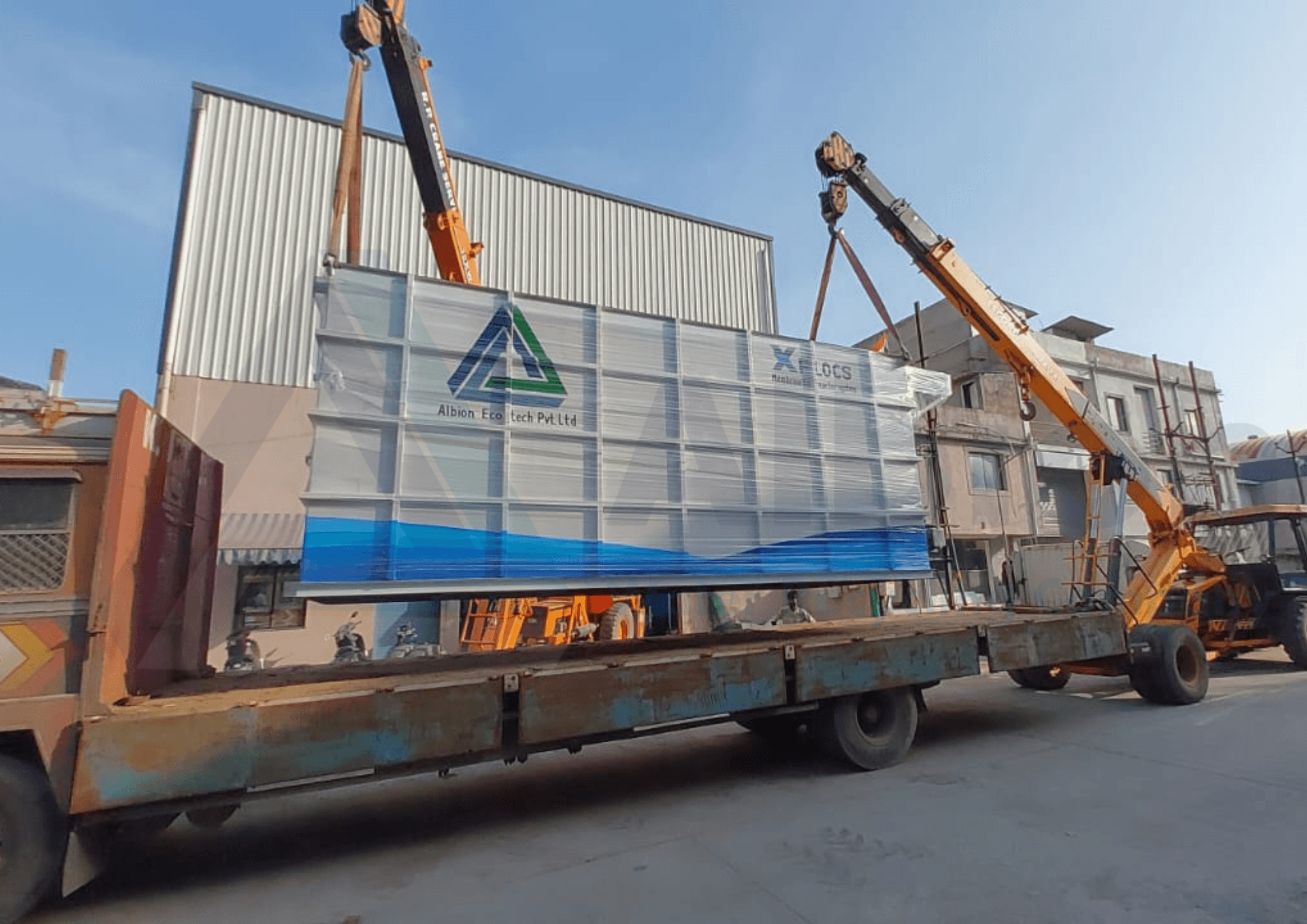
Process differences matter here. A carrier-based reactor such as M-Flocs AMBBR can treat the same load in a smaller volume than a conventional tank, and a membrane bioreactor like X-Flocs MBR does the same by holding more biomass, so comparing HRT across processes without knowing biomass concentration or carrier area can mislead.
Common mistakes when calculating HRT
- Using the full wall height instead of the side water depth, which overstates volume and HRT.
- Mixing units, such as volume in m³ with flow in litres per second, without converting.
- Using design flow when the plant actually runs at a lower or higher flow. HRT should be calculated for the flow the tank really receives, and checked at peak.
- Counting dead volume such as sludge hoppers, equipment, baffles or the space taken by diffusers and carriers as water that is available for treatment.
- Forgetting recycle. In activated sludge, nominal HRT uses the influent flow only, so the real time the liquid spends in the tank is shorter when recycle flows are added.
- Assuming nominal HRT equals actual contact time. Short-circuiting, where part of the flow bypasses the tank volume, makes the real residence time shorter than V ÷ Q.
- Confusing HRT with sludge retention time (SRT). HRT is about the water, SRT is about how long the biomass stays in the system. They are different numbers with different jobs.
How to check actual HRT in an existing plant
To check an existing plant, measure the tank dimensions and the water level, and read the flow from a flow meter totaliser over a full day rather than relying on pump ratings. Compare the calculated HRT with the design value at average and peak flow. If a plant is performing worse than expected, a tracer test can show whether the real residence time is shorter than the nominal one. A harmless tracer such as salt or a dye is dosed at the inlet, and its concentration at the outlet over time shows the mean residence time and any short-circuiting. Where the real time is short, baffles, better inlet and outlet arrangement or mixing changes can recover capacity.
How HRT is used in design
Albion Ecotech checks HRT in every tank at average and peak flow when it designs a plant, together with loading, sludge age and oxygen demand, and confirms the result against measured site data instead of relying on a single rule of thumb. Where flows or strength are likely to change, such as a growing township or a factory adding capacity, the design allows for it by sizing equalisation generously or by choosing a process whose capacity can be raised later within the same tanks. For a general introduction to how the stages fit together, see the guide to what a wastewater treatment plant is.
Albion Ecotech designs sewage and effluent treatment plants using SBR, MBBR or AMBBR and MBR processes, with UF, RO and ZLD options for water reuse, sludge management, energy-efficient equipment and PLC-based automation, in packaged or civil formats.
Frequently Asked Questions
What is HRT in a sewage treatment plant?
Hydraulic retention time is the average time wastewater spends in a tank, calculated as the tank's working volume divided by the flow rate passing through it. It shows how much time a tank gives for biological treatment, settling or disinfection.
What is the formula for HRT?
HRT = V ÷ Q. With volume in m³ and flow in m³ per day, multiply by 24 to get the answer in hours.
How do I convert KLD to an hourly flow for HRT?
1 KLD equals 1 m³ per day. Divide by 24 to get m³ per hour, for example 500 KLD is 20.8 m³ per hour.
What is a typical HRT for an aeration tank?
It depends on the process. Conventional activated sludge is often around 4 to 8 hours, and extended aeration in packaged plants is longer, often 18 to 36 hours. Carrier-based and membrane processes are usually shorter for the same load. Confirm against the design code or supplier data.
What is the difference between HRT and SRT?
HRT is how long the water stays in a tank. SRT, or sludge age, is how long the biomass stays in the system. In activated sludge, SRT is controlled by wasting sludge and is usually much longer than HRT.
Does return sludge flow count in HRT?
Nominal HRT in activated sludge is based on the influent flow only. Recycle flows shorten the actual time the liquid spends in the tank, which is why design codes state clearly which flow they use.